Main
Events
Guests
American Panels
Japanese Panels
Masquerade
Extra
Anime
Expo
AX
Memories Home
|
 |
Japanese
Guest and Industry Panels |
| |
Focus:
Haruhiko Mikimoto |
| |
|
 One
of the most popular character designers to this day, Haruhiko
Mikimoto answered many eager questions posed by the
audience. Summarizing most of the answers, Mikimoto
started out drawing simple characters in grade school and moving
on to full mangas in his junior high school years. He went
on to share many manga shorts with fellow artists and soon
decided to focus his skills at Studio Nue. It was there he
met and befriended Shoji Kawamori (mecha designer behind the Macross
Valkyrie) who recommended that he work on a new mecha show
project with him. Mikimoto submitted his designs to the
glee of the producers and the rest is history. In
retrospect, Mikimoto sketched Minmei out as a girl-next-door
type, but as the show progressed, so did her personality.
The Macross TV series essentially got most of its
influences from pop culture; fashions, idol singers, comedy, and
strong females. Asked about his personal profile, Mikimoto
gave thoughts about his favorite medias to work with. He
preferred water colors for drawing and oils for background
scenes. As for his "HAL" signature seen on all
his works, he was known as "Haru" to friends and
colleagues, but when 2001 A Space Odyssey was in
vogue, he decided to go with "HAL" as his popular
signature. Asked which out of all his characters who were
his favorite, he smiled and responded with "that is an
often asked question," and said he'd leave that to
impartiality because he doesn't take a personal preference to
any of his characters. Designs are submitted to the
producers and then subsequently more stylish designs are done
according to how the show progresses. Asked about
the status of Marionette Generation
manga, he confessed that the story tends to get lop-sided and
bored or stressed out at times... it was thought of at the last
moment. In Mikimoto's spare time, he enjoys photography
instead of drawing to relax himself. One
of the most popular character designers to this day, Haruhiko
Mikimoto answered many eager questions posed by the
audience. Summarizing most of the answers, Mikimoto
started out drawing simple characters in grade school and moving
on to full mangas in his junior high school years. He went
on to share many manga shorts with fellow artists and soon
decided to focus his skills at Studio Nue. It was there he
met and befriended Shoji Kawamori (mecha designer behind the Macross
Valkyrie) who recommended that he work on a new mecha show
project with him. Mikimoto submitted his designs to the
glee of the producers and the rest is history. In
retrospect, Mikimoto sketched Minmei out as a girl-next-door
type, but as the show progressed, so did her personality.
The Macross TV series essentially got most of its
influences from pop culture; fashions, idol singers, comedy, and
strong females. Asked about his personal profile, Mikimoto
gave thoughts about his favorite medias to work with. He
preferred water colors for drawing and oils for background
scenes. As for his "HAL" signature seen on all
his works, he was known as "Haru" to friends and
colleagues, but when 2001 A Space Odyssey was in
vogue, he decided to go with "HAL" as his popular
signature. Asked which out of all his characters who were
his favorite, he smiled and responded with "that is an
often asked question," and said he'd leave that to
impartiality because he doesn't take a personal preference to
any of his characters. Designs are submitted to the
producers and then subsequently more stylish designs are done
according to how the show progresses. Asked about
the status of Marionette Generation
manga, he confessed that the story tends to get lop-sided and
bored or stressed out at times... it was thought of at the last
moment. In Mikimoto's spare time, he enjoys photography
instead of drawing to relax himself. 
|
| |
Focus:
Producing Anime
Attending Guests: Junco
Ito (Producer of Kabuto), Buichi
Terasawa (Kabuto, Cobra, Midnight
Eye Goku), Haruhiko Mikimoto
(Macross, Gundam 0080), Yoshiyuki
Tomino (Gundam), and Ken
Iyadomi (Akira Committee, L.A. Hero
Producer for Guyver and Orguss). |
 |
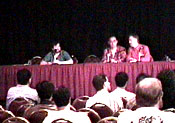
| View
of the panel proceedings |
 |
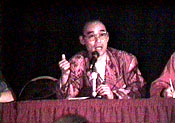
| Ken
Iyadomi (center) |
 |
| Buichi
Terasawa (second from left) |
 |
| Yoshiyuki
Tomino (center) |
 |
| Junco
Ito (center) |
 |
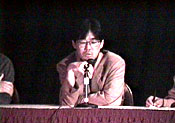
| Haruhiko
Mikimoto (center) |
|
| |
|
Following
is an excerpted transcript of the panel in response to questions
from the audience:
Iyadomi: The position of Japanese
animation is not well understood yet. Licensing and the
U.S. entertainment market is very large. We're still in
the promoting stage, spreading what
Japanese animation is like through the fans.
Terasawa: There are many levels of control
all of which involve numerous designs, story, etc.
Tomino: Absolutely, and the work cannot
really begin without guarantee of TV broadcast, especially for shows with giant
robots. Mecha shows cannot begin without a sponsor, a toy lineup,
etc. Trying to satisfy all these conditions and incorporate unique ideas to make show different and special
is very hard.
Junco: But then, not all productions are like
Tomino's. Most producers only need to control budget, licensing,
and the creations.
Iyadomi: And Bandai wants to bring
Gundam to US but they don't have the rights.
Terasawa: Of course, there
are many different types of animation. The first type is
the comic-to-anime in which a great deal of control is given to
the original writer/artist. The second type is original story-to-anime
in which the producers have more control.
Tomino: Every ten years, TV programming changes.
In the early years, the important thing was ratings by comics or stories.
Then came direct links to merchandising; products for girls and guys.
Then came the anime produced to increase sales of those products
like video games, model kits, and toys. People wanted to identify good
products with good shows. Of course, a master like
Miyazaki started out with side-stories and is an
exception. From an economic standpoint, a show should be able to recuperate from
the investment.
Junco: Nowadays, anime is
refreshingly developing more into a medium for artistic expression.
As for the rising number of anime companies to produce all this
anime, a few thousand of those companies are actually 3-10 person animation
groups. Very few animation companies have 10 people or more.
Tomino: If you look at the credits, you'll notice repeats of
a lot of names (multi-tasking staff).
Mikimoto: Doing many things
supplements income such as with stories, artworks, and character designs when you are popular.
Terasawa: Manga makes good money,
and spending the money to make good anime works well, too.
Junco: The bigger the production, the better it
is. Unfortunately, theatrical releases to OAV budgets are 10 to 1, but return is about the same.
We have to make do with tiny budgets unlike Disney.
Mikimoto: With increases in
the quality of animation production, studios like to emphasize with characters that look more
colorful and stylish.
Tomino: Japanese are envious of foreigners,
and they want characters that look more like Caucasians.
We've developed a complex where we should embrace foreign relations with
a more international look. This aspect of Japanese anime can be exploited very effectively.
Terasawa: I believe it's the
complexes of war, the Disney complex.
Junco: As well as influenced from
American sci-fi films. Shoujo manga takes influences
from the European aristocrats.
Tomino: Unfortunately, good
animation requires too many people and labor costs eat up budget.
In the future, CG may help with extra labor. The staff don't make a lot of money,
and at this point, I don't recommend entering the anime
field. The most frustrating part about producing anime are the businessmen who don't care about quality creative controls.
Junco: A worldwide global market would probably be considered.
Iyadomi: If I had the power,
I'd bring more anime over to US first.
|
| |
Focus:
Yoshiyuki Tomino |
|
| |
|
Single-handedly
the most popular producer of his time, Tomino has crafted a unique story
and molded it into an amazing giant robot show that devours the competition with its style and action and has
amassed a large number of copycat shows to reap the benefits. But Tomino is quite a humble man, as most fans could tell in his panel, and admits that
Gundam is the worst example of title use for a show's success. To summarize most of the answers,
Gundam started out as a three-volume novel series and should have ended there. It was a mistake to stretch it to a span of
10 years through Zeta Gundam and Double Zeta Gundam and much regretted, but the
Gundam title was needed for marketing. The subsequent
Char's Counterattack movie was supposed to wrap up the entire story by bridging the gaps between
Zeta and Double Zeta. It didn't stop there. New creative works such as
Gundam 0080, 0083, F-91 movie, and a possible new TV series (later known as
V-Gundam) took the throne and helped breathe new life into the Gundam universe with better stories, more realistic mechas, and a wider variety of
influential characters, and Tomino is honestly happy to see that.
Tomino had much to say when asked about the making of Gundam and the roots behind the show's success. The original
Gundam story was actually never influenced by Heinlein's
Starship Troopers story...the show came first and then he read the book after, noticing some of the parallels of the
power suit universe. Of course, Heinlein's power suits were vastly smaller than
Gundam's Mobile Suits. Tomino also added that as
influential as Gundam is, we will most likely not see a real Mobile Suit any time in the near future, but it
would be gratifying to see something like it on a smaller scale. The concept for the show was influenced by
2001 A Space Odyssey and Kurosawa's action films, and it there ever were an LD release for
Gundam in the United States, Tomino had to first come up with 80,000 friends who would definitely buy it.
Confronted with the Newtype concept, Tomino responded that it is like attaining enlightenment in the realistic sense of earthly religions. He joked that he could not really explain it well because he is an
Oldtype so had to describe the experience through his characters in many different ways throughout his novels.
|
| |
Panels
were also held for Buichi Terasawa
(Kabuto, Cobra, Midnight Eye Goku) Junco
Ito (Kabuto), and Keiji
Nakazawa (Barefoot Gen)
|
|
|